


Understanding Whetstones
A whetstone, also known as a sharpening stone, is a crucial tool for maintaining the sharpness of your kitchen knives. Available in various materials such as natural stone, synthetic composite, and diamond, whetstones come in different grits suitable for honing, sharpening, and finishing edges. The grit rating plays a vital role in determining how much material will be removed from the blade.
- Low Grit (200-600): Ideal for repairing dull edges, removing nicks, and reshaping blades.
- Medium Grit (800-2000): Perfect for sharpening dull blades, achieving sharper edges.
- High Grit (3000-8000): Primarily used for polishing and refining the edge for a razor-sharp finish.
Choosing the Right Whetstone
Select a whetstone based on your knife’s material and the extent of dullness. Softer stainless steel knives require finer grit stones, while harder blades might benefit from medium to low grit options.
- Best Options: If you’re starting, a double-sided whetstone with both coarse and fine grit (1000/4000) is a fantastic investment.
Preparing the Whetstone
Before starting the sharpening process, it’s essential to prepare the whetstone for optimal results.
- Soak the Stone: Soak your whetstone in water for at least 10-15 minutes if it’s a water stone. This soaking allows the stone to moisten and creates a slurry that helps the sharpening process.
- Secure the Stone: Place the whetstone on a non-slip mat or a damp cloth on a stable surface to prevent movement during sharpening.
Sharpening Your Knife
Understanding the correct angle and technique is crucial for effective sharpening.
Angle Positioning: The ideal sharpening angle typically ranges from 15 to 20 degrees for kitchen knives. To maintain this angle, you can use a guide or visual cues based on the thickness and design of your knife.
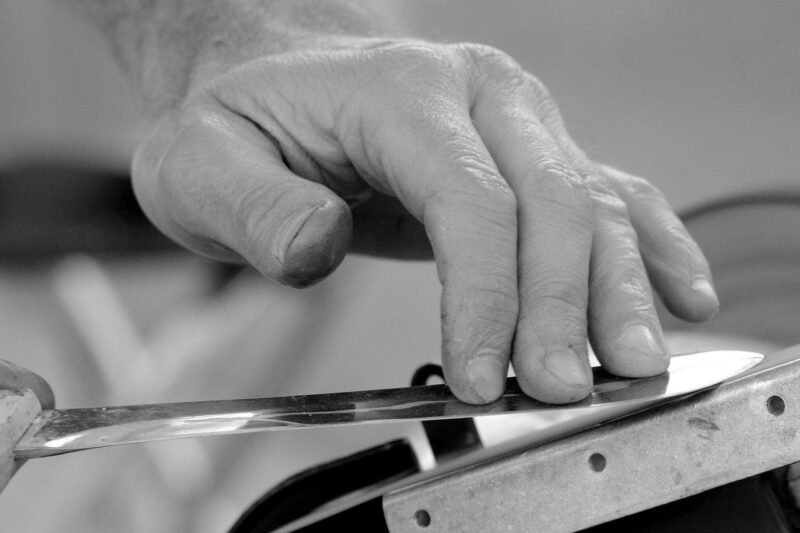
Hold the Knife: Grip the handle firmly with your dominant hand and place your other hand on the blade’s spine to control the angle.
Sharpening Motion:
- Begin at the heel of the blade, drawing it across the whetstone toward the tip.
- Use smooth, even strokes, maintaining consistent pressure.
- Alternate sides after about 5-10 strokes on one side, working up to 10-15 for dull blades.
- If using a dual-grit stone, switch to the finer grit after achieving a sufficient edge on the coarse side.
Techniques for Sharpening
- Straight Edge: Keep the blade flat while moving it away from you in a sweeping motion.
- Curved/blade tip: For curved knives, apply a rotational motion to work the stone’s surface effectively.
Testing the Sharpness
After sharpening, it’s essential to test your knife’s sharpness. A simple paper test can be effective: try slicing through a piece of paper. If the knife cuts effortlessly, it’s sharp. If it tears the paper, more sharpening is required.
Cleaning the Whetstone
After sharpening, rinse the whetstone under water to remove metal filings and residue. Dry it with a soft cloth before storing. Adequate care extends the lifespan of your stone and ensures hygiene for future use.
Maintaining Your Knife
To keep your knife sharp longer, perform regular maintenance.
- Honing: Use a honing steel or rod after each use to realign the blade’s edge.
- Proper Storage: Store knives in a wooden block, magnetic strip, or sheath to prevent dullness from touching other surfaces.
- Avoiding Dishwashers: Never place knives in the dishwasher as it can chip blades and affect the edge.
Safety Precautions
While sharpening knives can be quite straightforward, safety should never be overlooked. Here are critical points to keep in mind:
- Handle with Care: Always handle the knife by the handle and keep fingers away from the edge.
- Stability is Key: Ensure the whetstone is stable before starting to avoid slipping.
- Focus: Maintain concentration throughout the process; distractions can lead to accidents.
Common Mistakes to Avoid
- Incorrect Angle: Failing to maintain the correct angle can cause uneven sharpening and damage to the blade.
- Over-Exerting Pressure: Excessive pressure can lead to undesirable edge damage. Move with controlled strokes.
- Skipping Grit Levels: Neglecting to start with a coarse stone when dull can result in ineffective sharpening.
Advanced Sharpening Techniques
As confidence builds, explore advanced techniques to sharpen specialized knives or tackle particular issues.
- Edge Camping: For knives with a thicker spine, consider adjusting the angle slightly to create a custom edge profile.
- Polishing: After sharpening, polishing with a leather strop can help create a mirror finish and further enhance sharpness.
FAQs
How often should I sharpen my knives?
It depends on usage frequency, but a good rule of thumb is to sharpen them every few weeks or whenever you notice difficulty in cutting.
Can I use oil instead of water?
Some stones are designed for oil, but most kitchen knives perform better with water stones. Ensure compatibility with your whetstone’s material.
Is it necessary to buy multiple whetstones?
Initially, a dual-grit stone suffices. As experience grows, you may want to invest in specialized stones for different tasks.
By mastering the art of whetstone sharpening at home, you ensure your knives remain efficient and safe for culinary adventures. With patience and practice, you’ll develop the skill to maintain and refine your kitchenware, enhancing both performance and longevity.